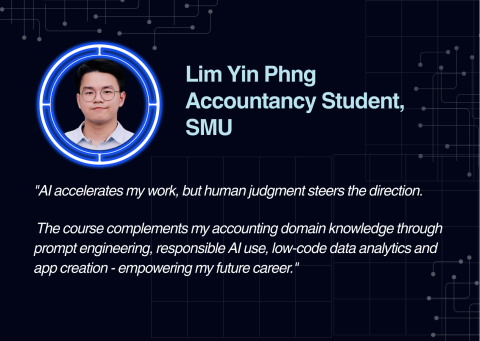

New Bachelor of Accountancy Course: AI Literacy for Accounting Professionals
Since 2018, SMU School of Accountancy (SOA) has been offering courses that incorporate Non-Generative Machine Learning, Optimisation, and Simulation—AI techniques widely used in accounting. These courses develop skills in forecasting, anomaly detection, and knowledge discovery, preparing students to leverage AI for data analytics and problem-solving.
As new AI technologies emerge, SOA is committed to reviewing its curriculum offerings to bring the most relevant and applicable content for its students. We aim to equip our Accountancy students with the tools to navigate both the possibilities and risks these technologies introduce.
In January 2026, we launched the new course "AI Literacy for Accounting Professionals", which was developed in consultation with AI Singapore and Amazon Web Services (AWS) Academy. This course provides the foundational literacy needed to engage critically and effectively with AI-driven tools in accounting contexts.
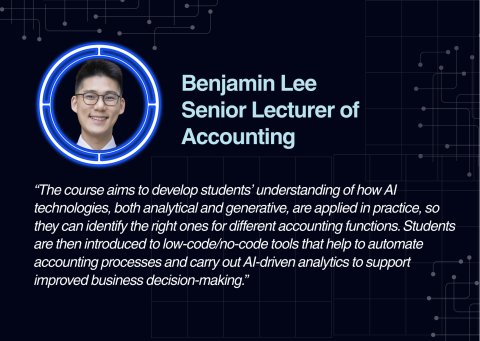
Students will gain hands-on experience with no-code/low-code software that can be used for building visual workflows to clean, transform, analyse, and visualise accounting data. These workflows serve as a foundation for applying AI-driven analytics without requiring programming experience. They will also build conceptual fluency in Generative AI, including how foundation models operate, how prompts shape model outputs, and how to approach the use of such systems responsibly and ethically in accounting and other professional contexts.
Students in the course will learn to:
1. Describe how AI technologies can support accounting functions, and identify opportunities and risks associated with their use in areas such as transaction processing, reporting, and audit.
2. Use low-code tools to clean, transform, and analyse accounting data, and document visual workflows for tasks such as reconciliation, anomaly detection, and forecasting.
3. Apply classification, regression, and clustering techniques to detect patterns and generate insights from financial and operational datasets.
4. Design and evaluate effective prompts for generative AI systems, and use them to generate summaries, draft narratives, or interpret accounting data.