

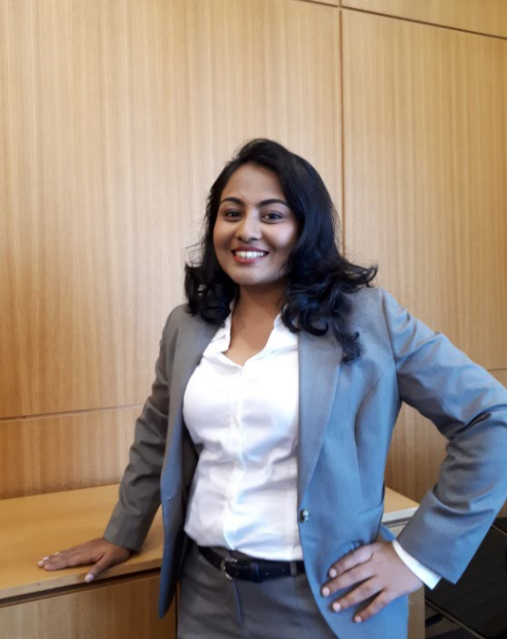
As we wind up the first quarter of the year, it is time we start prepping for graduation season. The MPA May cohort will take their final exams and in a flash, a year has gone by and they are now about to start a new chapter in their lives.
For the Master of Professional Accounting (MPA) programme, a long break is set aside between terms 2 and 3 for students to look for internship opportunities. This is a great way for international students to get a foot into working in Singapore and landing a full time role after graduation. Sometimes, we have students who already had some years of working experience, in which case, they wonder if an internship would be useful for them. Today, we speak to Marium Alexander, who was working in India for 3 years prior to coming to Singapore for the MPA programme.
Hi Marium, could you introduce yourself and why you decided on the MPA?
My undergraduate degree is a Bachelor of Commerce, specializing in Finance and Taxation. After graduating from Indira Gandhi National Open University, I worked for about 3 years as an external auditor in KPMG, India.
I chose to pursue MPA in SMU to understand practical aspect on accounting, gain working knowledge on IFRS and also for a campus experience since I’ve pursued my undergraduate studies with an open university. I also was keen to gain exposure on working in a multi-cultural environment as the real work environment is increasingly becoming diverse in all respect.
I understand that you managed to also get an internship during the winter break in KPMG. Could you share the interview process with us?
I had several interviews lined up prior to my internship. It was between some of the Big Four firms and an MNC. For the Big 4 firms, the interview questions mostly revolved around benefits of working in a team, situational questions where you have obtained better results working in a team vs if you would have finished the assignment individually, challenges faced during prior work or project work and how I overcame it, experiences where I was faced with an unethical situation and how I handled it.
For the MNC interview, I was asked if I would choose efficiency or accuracy as an accountant, and what precautions will I will take to manage the expectations from your reporting officer.
I think the underlying interview questions was to ascertain if the role is the right fit for me and my situational awareness in the industry. Eventually, I picked KPMG to do my internship as it was more aligned to my career goals.
Could you share with us a typical day as an intern.
A typical day as an audit intern in a Big Four firm usually involves preparing working paper, asking seniors on how to prepare the working papers, liaising with the client for data etc.
Since I had prior experience as an auditor, I was in-charge of the substantive testing for the account heads for all the entities in our audit scope. For interns without prior audit knowledge, the typical responsibilities would involve vouching, audit of cash and bank, scanning and archiving important documentary evidences and any other areas the senior wishes to entrust.

[Photo: Marium, first from left, together with her colleagues from KPMG]
How did the MPA programme prepare you for this internship? Were the modules that you learnt relevant to the scope of work that you did there?
The MPA program provided me exposure of working in a multi-cultural teams during group project and also the requisite technical knowledge through the completion of the following modules working ACCT611-Financial Accounting, ACCT612-Corporate Reporting & Financial Analysis and ACCT621-Audit and Assurance.
Do you have any advice for students looking for an internship?
Application and interview stage – Be early while submitting the application and for the interview. As being late can completely diminish all chances of securing the position despite having all the merits required. Keep in touch with the career department and take at least one mock interview.
While pursuing the internship – Interns should show eagerness to learn not only by asking the seniors relevant question but also reading up on the technical literature (accounting and auditing standards). They should not show reluctance to perform some mundane and administrative works like scanning and roll forwarding work paper etc. Try to be as resourceful as possible by showing willingness to help out the audit team in whatever way possible and stay back after the office hours if required. Take all this in stride for professional development. Since the internship is only for a short duration of 10 weeks, the expectation with respect to exposure and learning has to be managed. The opportunities received and the internship experience of each intern directly depends on the engagement he/she is plotted on, the senior plotted in the engagement. Therefore the experience of seniors doesn’t need to be the same as what you should expect. Keep an open mind and enjoy the experience as it is with little expectations!
Last question before we end, what are your career goals going forward?
My short term goal is to continue my career as an auditor and to specialise in one industry (preferably audit of technology companies). Forensic audit is also one area I am keen to pursue as well, as a previous external auditor I have transferable skills to offer to the profession. I also wish to be a trainer to share the experience I have acquired in my professional journey. In the long term, I wish to assume a leadership position and build competencies to be an indispensable resource to the organisation I’m part of.