

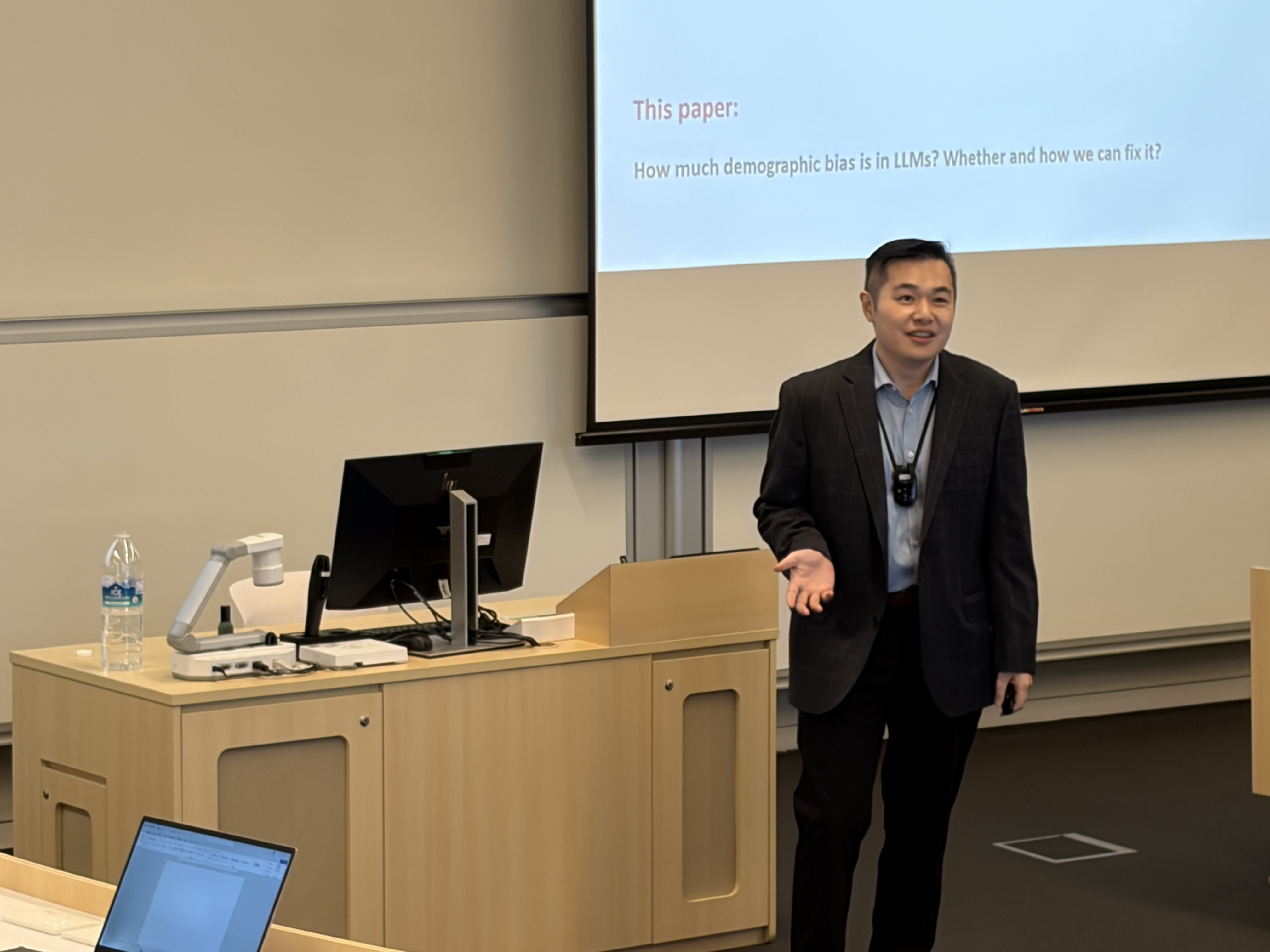
Not all biases are visible, and not all decisions are as independent as they appear. At the Tri-University Accounting Research Conference 2026, two research papers by SMU School of Accountancy (SOA) faculty challenged participants to look more closely at how judgement, context and hidden influence shape decision-making.
Hosted this year by Nanyang Technological University (NTU), the conference brought together faculty members from SMU, NTU and the National University of Singapore (NUS). Held annually on a rotating basis, the conference serves as a platform for the exchange of research ideas and constructive feedback between junior and senior scholars. Through this process, papers are refined and strengthened, contributing to the overall quality and rigour of academic research in accountancy.
Understanding bias in AI-generated financial recommendations
The two SMU papers examined how emerging forces influence judgement in both financial analysis and the workplace. Concerns about bias in artificial intelligence have grown alongside its adoption, particularly in applications involving financial judgement such as stock recommendations.
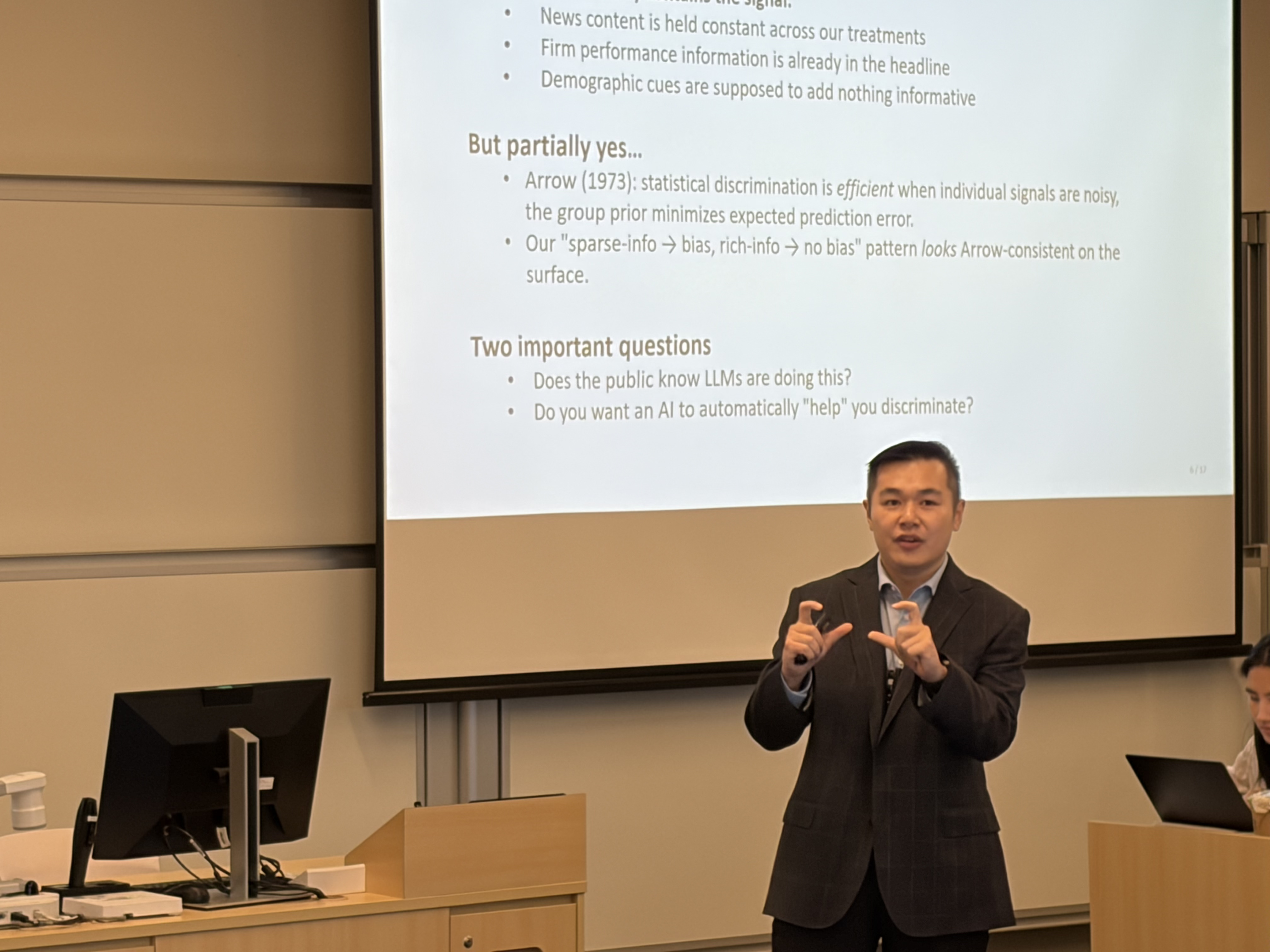
Dan Li, Assistant Professor of Accounting at SMU SOA, examined this issue in his paper, “Demographic Bias in LLM-Generated Stock Recommendations”. The study was co-authored with Qiang Cheng, Lee Kong Chian Chair Professor of Accounting at SMU SOA, and Yanxi Hou, an SMU SOA PhD candidate.
“We have seen many papers that talk about the strengths of AI, but we need to take a step back and rethink about if there’s any risks associated with that,” Professor Li said, noting that the research remains in its preliminary stages and contributes to a growing body of work examining gender and racial bias in AI systems.
Early findings suggest the presence of demographic bias in stock recommendations generated by large language models (LLMs).
The paper also suggests that training data can transmit embedded associations between CEO demographics and firm performance into model outputs. Rigorous dataset curation is therefore critical to reducing bias and improving the reliability of AI-driven financial tools.
The presentation generated strong interest from the audience, sparking extensive discussion around potential refinements to the methodology and suggestions for additional tests that could further strengthen the robustness of the findings.
The influence of stock price signals on employee decisions
The second paper from SMU turned to a different, but related, question: how financial information shapes behaviour beyond the investor community.
Presented by Zitong Zeng, Assistant Professor of Accounting at SMU SOA, the study titled “Stock Price Information and Employee Career Decisions” was co-authored with Pengkai Lin and Rencheng Wang, both from SMU SOA.
Historically, most rank-and-file employees had limited exposure to stock market information. Price signals simply were not part of their everyday lives in the way they are today. However, the rise of trading platforms such as Robinhood, alongside the proliferation of financial content, has made such information more accessible to ordinary workers, including those with limited background in finance.
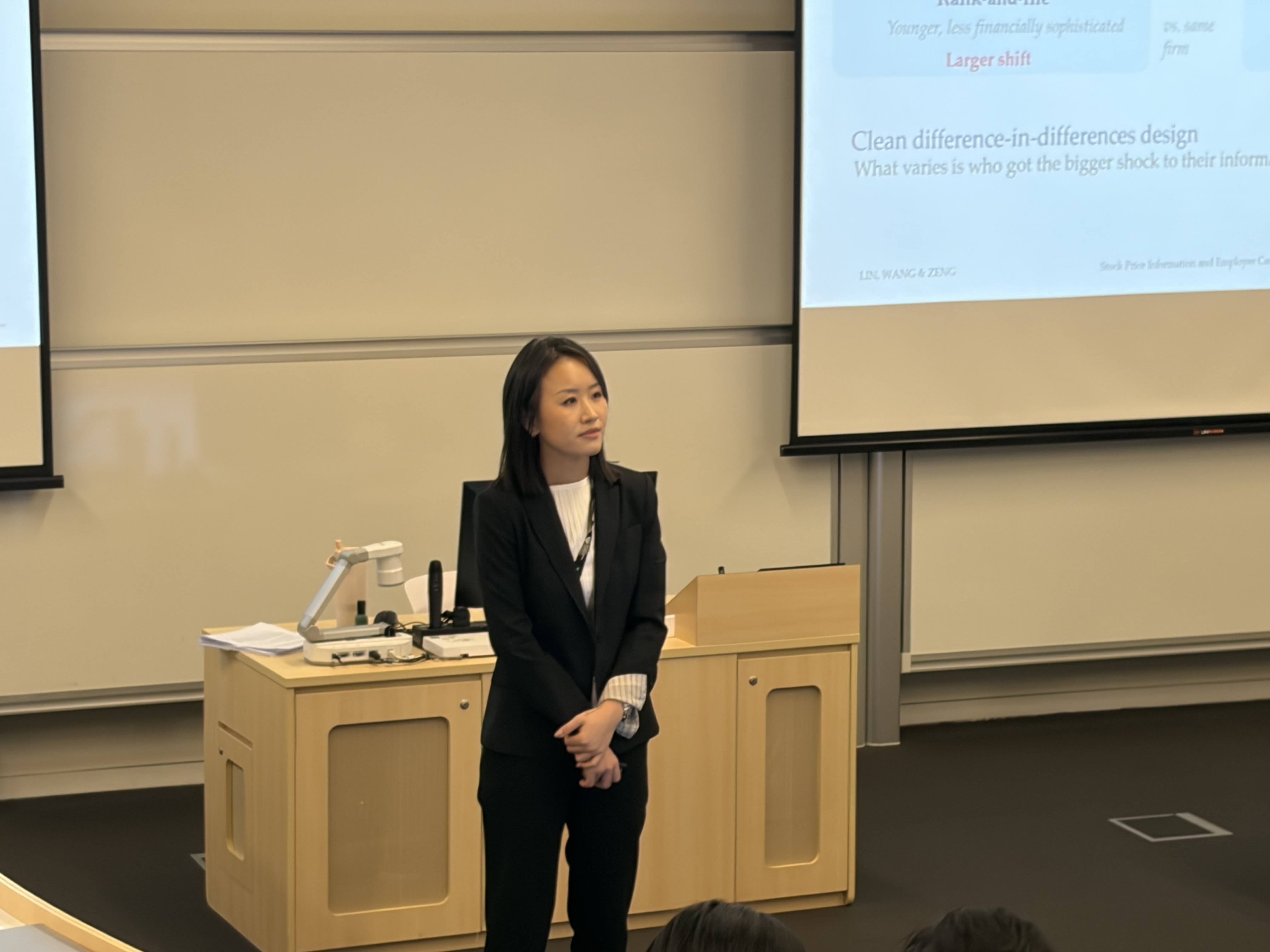
and Assistant Professor Lin Pengkai
“On the information side, we’re seeing this large explosion of financial content. News apps… stock podcasts telling you which stock to pick… then we also have social media,” shared Professor Zeng. “Even if employees are not directly participating in the stock market, they are constantly exposed to price signals.”
This shift in exposure led the authors to ask whether stock price information influences the career decisions of rank-and-file employees from various publicly-listed firms. Using a LinkedIn-based résumé dataset, the study matched employment histories with firm-level stock performance to analyse patterns in employee turnover.
The findings indicate that following the post-2020 rise in retail participation, rank-and-file workers became significantly more sensitive to their firm’s stock returns when making departure decisions, a shift that was not observed among managers at the same firms, who were already financially literate before 2020. However, departure decisions become less well-calibrated when price movements reflect noise rather than firm fundamentals. The results demonstrate how employees, much like retail investors who trade on noise, appear unable to filter non-fundamental price fluctuations from signals about their firm’s prospects.
By establishing that increased stock market exposure shapes how ordinary workers make career decisions, the study connects developments in financial markets to labour market behaviour, extending the real effects of stock prices beyond the executive suite.